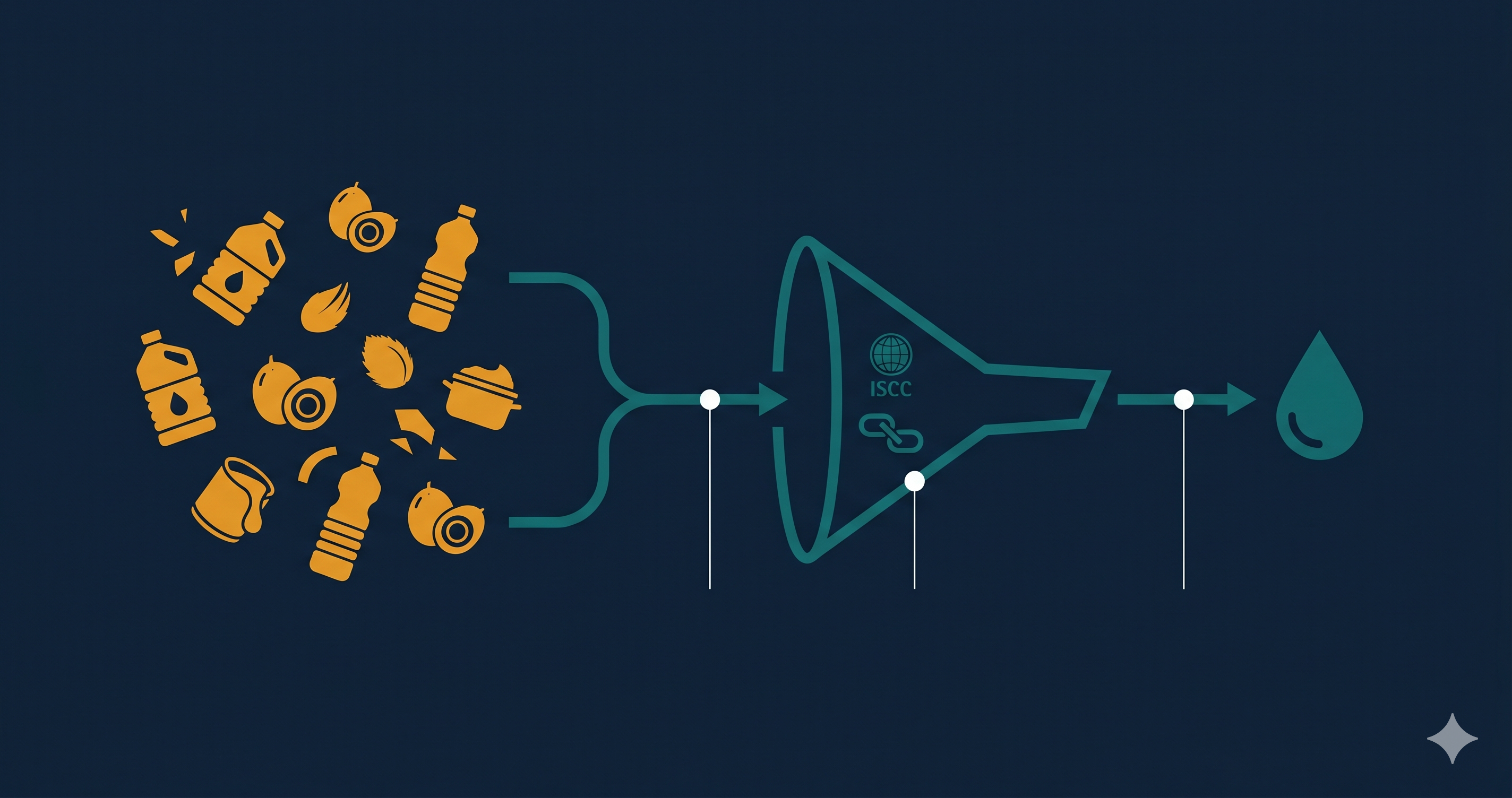
Thailand's sustainable aviation fuel blending mandate is now in force. The Alternative Energy Development Plan (AEDP) requires a 1% SAF blend starting in 2026, rising through phased targets to 8% by 2037. The target is mandated, backed by installed refining capacity that is being built today. Domestic demand: 67,000 tonnes in the first phase, rising to over 605,000 tonnes by 2037.
For feedstock suppliers — aggregators, collectors, processors, and traders handling waste lipids across Thailand and the wider CLMV corridor — this mandate rewrites the economics. Demand is no longer speculative. It is structural, phased, and growing at a rate that existing certified supply cannot meet.
The constraint is not volume. It is documentation.
Why the Thai SAF mandate matters now
Thailand is one of the first countries in Southeast Asia to legislate a binding SAF blending obligation. The mandate follows the HEFA pathway (Hydroprocessed Esters and Fatty Acids), meaning only specific waste-classified lipid feedstocks qualify. The mandate phases are structured as follows:
| Phase | Blend target | Estimated demand | Timeline |
|---|---|---|---|
| Phase 1 | 1% | ~67 kt/yr | 2026 |
| Phase 2 | 3–5% | ~225 kt/yr | 2030 |
| Phase 3 | 5–8% | ~360 kt/yr | 2033 |
| Phase 4 | 8% | ~605 kt/yr | 2037 |
These demand figures are not projections. They are derived from mandated blend ratios applied to Thailand's jet fuel consumption, and they will grow as air traffic recovers and expands.
On the supply side, installed HEFA processing capacity is expanding rapidly. Bangchak's HEFA plant is already operational. PTT GC, Zhuoyue, and alcohol-to-jet facilities are planned or under construction, collectively bringing Thai SAF processing capacity from approximately 336,000 tonnes in 2026 to over 730,000 tonnes by 2037. The refineries are being built. The feedstock supply chains to feed them are not.
Every one of those facilities needs certified, traceable, buyer-accepted feedstock with chain-of-custody that survives an audit.
What qualifies as SAF feedstock — and what does not
The HEFA route converts waste lipids into paraffinic kerosene (HEFA-SPK), certified and blendable up to 50% under ASTM D7566. But not all fats and oils qualify. Eligibility is constrained by both international frameworks (ICAO CORSIA, ReFuelEU) and Thailand's domestic mandate.
Eligible feedstocks
- Used cooking oil (UCO) — collected from restaurants, food manufacturing, and household collection programs. The largest near-term feedstock pool, but quality varies significantly by collection hygiene and contamination levels.
- Palm oil mill effluent (POME) — waste-classified sludge oil from palm oil milling. High potential, but eligibility depends on ISCC waste classification and chain-of-custody certification.
- Animal fats and tallow — rendered fats from meat processing, classified under EU categories (Cat 1, 2, 3). Category determines SAF eligibility and competition with animal feed markets.
- Free fatty acid distillate (FFA) — a byproduct of edible oil refining. A drop-in lipid feedstock, though it carries indirect land use change (ILUC) and food-versus-fuel scrutiny.
Excluded feedstocks
- Virgin palm oil
- Palm fatty acid distillate (PFAD) from dedicated palm cultivation
- Food and feed crops
- Soy oil and derivatives
The exclusion list is not advisory. Under ReFuelEU and CORSIA, feedstock that does not meet waste or residue classification is ineligible for SAF crediting. A refinery that accepts ineligible feedstock cannot count the resulting fuel toward its mandate obligation. Full stop.
Composition determines everything. Free fatty acid levels, moisture content, contamination profiles — these set whether a refinery accepts a lot, under which certification framework, and at what tier.
A refinery does not buy "UCO." It buys a lot that meets a specification — typically FFA below 5%, moisture below 1%, and no polyethylene contamination above threshold. Two collection batches from the same city, same week, can end up in different eligibility tiers based solely on the quality data attached to them.
The documentation is not overhead. It is what makes the lot tradeable at certified tier.
Aggregation without documentation is a commodity trade. Aggregation with auditable chain-of-custody is market access.
Thinking about your current feedstock documentation? ResourceLedger captures chain-of-custody evidence at the collection event — so every lot you deliver can be substantiated on demand. Request a walkthrough →
The certification frameworks that gate market access
Three certification frameworks govern SAF feedstock traceability. Which one applies depends on where the fuel is sold, which airline consumes it, and under what regulatory regime. Get the wrong one, and a certified lot becomes an uncredited delivery.
| Dimension | ISCC EU | CORSIA | RED III |
|---|---|---|---|
| Scope | EU market entry (renewable fuels) | International aviation emissions | EU overarching renewable energy |
| GHG saving threshold | ≥65% vs. fossil comparator | Reduction vs. CORSIA baseline (fuel-specific) | ≥65%, tightening over time |
| Chain-of-custody model | Mass balance | Mass balance or book-and-claim | Mass balance or physical segregation |
| Waste classification | Documented at point of origin | CORSIA-eligible feedstock list | Strengthened Annex IX criteria |
| Audit cycle | Annual, all operators in chain | Annual, approved certification bodies | Annual, EU-recognized schemes |
| Thai supplier relevance | Required for European offtake | Required for international airline sales | Umbrella for ISCC EU obligations |
The practical implication is straightforward. Different buyers require different certifications, and each framework has distinct documentation requirements. A supplier certified under ISCC EU may still need additional documentation for CORSIA-eligible sales. A lot that qualifies as waste under one framework may require different evidence under another.
If you are supplying a European refinery, you need ISCC EU. If your buyer sells fuel to international airlines under CORSIA obligations, you need CORSIA eligibility. If both — and increasingly, it is both — you need a single evidence base that satisfies both frameworks simultaneously.
Where most suppliers fall short
Holding an ISCC certificate is not the same as having audit-survivable chain-of-custody. The certificate attests that an operator's management system was assessed at a point in time. The chain-of-custody must survive transaction-level scrutiny for every lot, every period, every delivery. These are different things.
Three gaps surface repeatedly at audit:
1. Collection-level documentation is incomplete
A UCO aggregator collects from 200 restaurants across Bangkok. Collection receipts exist, but they record weight only — not FFA percentage, moisture content, source type, or collection method. When an ISCC auditor asks for evidence that the feedstock was waste-classified at the point of collection, the documentation trail ends at a number on a receipt.
This is the most common gap. Collection events are where chain-of-custody begins, and they are where documentation is weakest.
2. Mass balance records do not reconcile
ISCC requires mass balance accounting: inputs into a period must reconcile with outputs, losses, and closing stock. Many aggregators maintain inventory records, but those records were designed for commercial tracking, not regulatory compliance. When an auditor examines conversion factors, processing losses, and period-over-period balances, the numbers do not close.
The system was never designed to close them. That is the problem.
3. Waste classification lacks upstream evidence
POME, animal fats, and some UCO streams carry waste classification that gates their eligibility for SAF crediting. But the waste classification often rests on a self-declaration from the source facility rather than documented evidence. If the source is a palm oil mill, the auditor will ask for evidence that the POME was genuinely waste — not a co-product diverted from another use. If it is an animal fat renderer, the auditor will ask for EU category classification documentation.
Without upstream evidence, the waste classification is an assertion. Assertions do not survive audits.
What an ISCC auditor actually examines
These three gaps share a common root: suppliers document what they need for commercial transactions, not what an auditor needs for verification. The gap between those two standards is wider than it looks:
| Collection data point | What most suppliers record | What an ISCC auditor examines |
|---|---|---|
| Source identity | Supplier name | Named source facility, address, registration, consent documentation |
| Quantity | Weight on receipt | Weigh ticket with device calibration, cross-referenced against transport records |
| Quality parameters | Not recorded | FFA%, moisture, contamination — with lab results or handheld meter readings |
| Waste classification | Self-declaration or none | Documented evidence that source material meets waste/residue criteria under the applicable scheme |
| Collection method | Not recorded | Capture method, handling protocol, contamination controls |
| Timestamp | Date on receipt | Timestamped collection event, ideally with device attestation |
| Chain-of-custody link | Invoice to delivery | Every intermediary documented, with mass balance reconciliation at each node |
Most suppliers are on the left. Certification requires the right.
What feedstock suppliers should be doing now
The Thai SAF mandate is not a future event. Phase 1 is in force. Refineries are operational and contracting feedstock. The window to build compliant supply chains is not measured in years — it is measured in the time between now and your first delivery to a refinery that requires certified chain-of-custody.
-
Audit your collection-level documentation. Walk backwards from a single delivered lot to the collection events that comprise it. Can you produce evidence of source, quantity, quality parameters, collection method, and waste classification for every event? If any link requires a phone call or a manual lookup, that is the gap an ISCC auditor will find.
-
Verify your mass balance closes. Pull your last three operating periods and check whether inputs (certified and non-certified), outputs, losses, and closing balances reconcile. If your system was designed for commercial inventory tracking rather than ISCC mass balance compliance, the numbers will not close. That reconciliation failure is a non-conformance.
-
Classify your feedstock under the right framework. Determine which certification framework your target buyers require — ISCC EU, CORSIA, or both. Map each feedstock stream to its eligibility status under each framework, using the comparison table above. A lot that qualifies as waste under ISCC EU may require different documentation under CORSIA.
-
Formalize supplier onboarding. Every source in your supply chain — every restaurant, every palm oil mill, every renderer — needs documented consent, waste classification evidence, and a collection protocol that captures the data your certification requires. Informal relationships that work commercially do not work under audit.
-
Connect your evidence chain to broader compliance obligations. SAF feedstock traceability does not exist in isolation. The same evidence infrastructure that supports ISCC chain-of-custody also underpins EUDR due diligence requirements for palm oil supply chains and emerging CSRD disclosure obligations. Build evidence capture once, for multiple frameworks, rather than maintaining parallel systems.
Closing the evidence gap
We built ResourceLedger because the gap between holding a certificate and surviving an audit is where most commodity supply chains get stuck — and SAF feedstock is no exception. The same evidence infrastructure that supports EUDR due diligence for rubber and palm oil applies directly to the chain-of-custody challenges feedstock suppliers face.
The core problem is the same across commodities: evidence must be captured at the point of origin, not reconstructed later from commercial records. For SAF feedstock, that means structuring collection-level data — source identity, quality parameters, waste classification, timestamps — at the moment of collection, not assembling it from receipts when an auditor asks.
The three gaps described above — incomplete collection documentation, non-reconciling mass balance, and unsubstantiated waste classification — are evidence problems, not data problems. The difference matters: data collection systems record information; evidence infrastructure makes it structured, traceable, and reproducible for any reviewer.
ResourceLedger does not certify compliance. Certification determinations belong to auditors and certification bodies. What the platform provides is evidence infrastructure designed to make chain-of-custody audit-survivable across commodity supply chains. You can see how the platform works or explore the technical architecture in detail.
Frequently asked questions
What is the HEFA pathway for SAF production?
HEFA (Hydroprocessed Esters and Fatty Acids) is the dominant commercial pathway for producing sustainable aviation fuel from lipid feedstocks. The process strips oxygen from waste fats and oils and hydrogenates the carbon chains into paraffinic kerosene, certified as HEFA-SPK under ASTM D7566 and blendable up to 50% with conventional jet fuel. It is the only SAF pathway with significant installed production capacity in Thailand today.
Does Thailand's SAF mandate apply to international flights?
Thailand's AEDP blending mandate applies to domestic jet fuel supply. International flights are additionally covered by ICAO's CORSIA framework, which creates a parallel demand signal for CORSIA-eligible SAF and compounds the feedstock requirement beyond the domestic mandate alone. Thai refineries therefore face demand from both the domestic mandate and international airline obligations — and feedstock suppliers must be prepared to document chain-of-custody under both frameworks simultaneously.
Can a supplier hold both ISCC EU and CORSIA certification?
Yes. ISCC offers certification tracks for both EU regulatory compliance (ISCC EU) and CORSIA eligibility (ISCC CORSIA). However, the documentation requirements differ between the two frameworks, particularly around GHG lifecycle analysis methodologies and default emission factors. A supplier serving both European and CORSIA markets needs to maintain evidence that satisfies both frameworks, which in practice means more granular data collection at the source level.
What happens if feedstock fails waste classification at audit?
If an ISCC auditor determines that feedstock claimed as waste does not meet the waste classification criteria, the affected lots lose their sustainability certification. The downstream SAF produced from those lots cannot be counted toward mandate obligations or CORSIA credits. For the supplier, the lots revert to uncertified commodity status. For the refinery, it means a shortfall against their mandated blend ratio. The commercial consequences cascade in both directions, and the reputational impact compounds with each failed audit cycle.
If you are aggregating or processing SAF feedstock in Thailand and want to see how evidence-grade chain-of-custody works at the collection level, request a platform walkthrough.