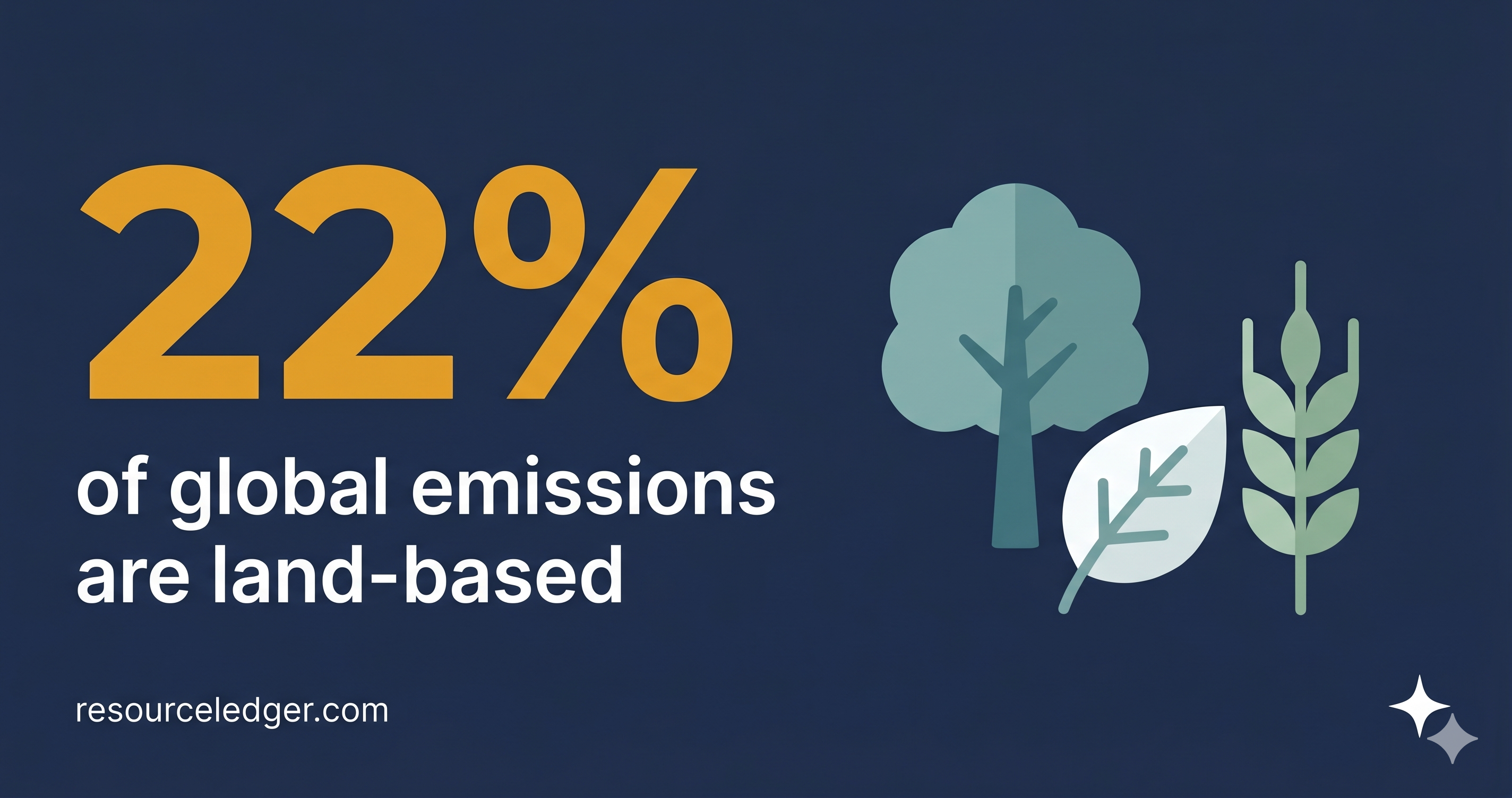
The food on our plates and the commodities in our supply chains account for roughly a fifth of global greenhouse gas emissions, yet until 2022, no standardized framework existed for companies to set science-based reduction targets for this massive source. FLAG (Forest, Land and Agriculture) emissions now sit at the center of a rapidly converging web of climate regulations, corporate commitments, and supply chain transformation.
Over 260 companies have already validated FLAG targets, and their Scope 3 commitments flow downstream to Southeast Asian rubber, palm oil, and cocoa suppliers who may not yet know they are in scope. This guide unpacks what FLAG emissions are, how they intersect with EUDR evidence, where the data gaps remain, and what the convergence means for exporters building traceability infrastructure today.
What are FLAG emissions?
FLAG emissions encompass all greenhouse gases generated through land use, land-use change, and agricultural production, from methane released by livestock to CO₂ liberated when forests are cleared for palm oil or rubber plantations.
The term FLAG is closely aligned with what the IPCC calls AFOLU (Agriculture, Forestry and Other Land Use), though the two are not identical:
| FLAG | AFOLU | |
|---|---|---|
| Owner | SBTi | IPCC |
| Purpose | Corporate target-setting | National emissions inventory |
| Scope | Company value chain (Scope 1 + 3) | Economy-wide |
| Includes removals? | Yes, within value chain | Yes, national-level |
| Target horizon | Near-term (5-10 yr) + 2050 | National NDCs |
The numbers are stark. According to the IPCC AR6 Synthesis Report, AFOLU accounted for 22% (approximately 13 GtCO₂-eq) of total net anthropogenic GHG emissions in 2019, the third-highest emitting sector after energy (34%) and industry (24%), and larger than all global transportation emissions (15%, or 8.7 GtCO₂-eq).
About half of AFOLU emissions originate from agricultural production (livestock methane, fertilizer nitrous oxide, rice cultivation) and half from land use, land-use change, and forestry. In commodity supply chains, land-use change is often the category that determines whether a FLAG inventory is credible or merely estimated.
How the SBTi FLAG guidance reshaped land-based emissions
The Science Based Targets initiative launched its Forest, Land and Agriculture guidance on September 28, 2022, the world's first standardized methodology enabling companies to set science-based targets that include land-based emission reductions and removals. The current V1.2 became effective on March 19, 2026, according to SBTi's V1.2 change document.
Who must set FLAG targets?
Companies in six designated sectors are required to set FLAG targets when seeking or maintaining SBTi validation: food production (agricultural and animal source), food and beverage processing, food and staples retailing, forest and paper products, and tobacco.
A critical threshold rule extends the requirement further. Companies in any sector must set FLAG targets under SBTi validation rules if land-related emissions exceed 20% of their total Scope 1, 2, and 3 emissions. This captures many companies that wouldn't consider themselves agricultural businesses, including apparel and footwear brands sourcing cotton, wool, leather, and viscose.
Two target-setting approaches
The FLAG Sector Pathway applies an absolute reduction rate of 3.03% per year from the base year. It is recommended for demand-side companies like processors, retailers, and brands. For a company using a 2020 base year targeting 2030, this translates to roughly a 30.3% reduction.
The Commodity Pathway provides intensity-based targets (tCO₂e per tonne of product) for 11 specific commodities: beef, chicken, dairy, leather, maize, palm oil, pork, rice, soy, wheat, and timber/wood fiber. Each has unique decarbonization rates adaptable across 26 global regions.
The no-deforestation mandate
All FLAG targets must include a mandatory no-deforestation commitment. Under V1.2, companies have up to two years after FLAG target submission to achieve this, with an absolute deadline of December 31, 2030. The updated guidance now requires coverage of the seven EUDR commodities (cattle, cocoa, coffee, oil palm, rubber, soy, and timber) when any of these exceed 5% of total gross FLAG emissions.
Long-term targets require reducing at least 72% of FLAG emissions by 2050, aligned with the SBTi Net-Zero Standard.
Corporate adoption is accelerating, but gaps remain
As of mid-2026, more than 260 companies have validated FLAG targets, with the pace of adoption doubling in 2025 compared to the prior year (SBTi Companies Taking Action dashboard). Over 1,000 additional companies have committed to set FLAG targets.
A WWF analysis of the first 149 validated FLAG targets revealed that 74% came from European companies, with Asia contributing only 13, a significant geographical imbalance. Food and beverage processing dominated (73 companies), followed by food retailing (16) and textiles/apparel (14).
Critically, all 149 initial FLAG targets included Scope 3 emissions, while only 27 included Scope 1. FLAG is fundamentally a supply chain challenge for most companies.
Who has committed, and what it means for suppliers
FLAG adoption is concentrated in European food and consumer goods companies. That matters because their Scope 3 FLAG commitments create downstream evidence expectations for Southeast Asian commodity suppliers, even if those suppliers have no SBTi engagement of their own.
Wilmar International (FLAG targets validated March 2025, 36.4% Scope 1+3 reduction by 2032) and SD Guthrie (first palm oil SBTi validation, December 2023, 42% Scope 1+2 reduction by 2030) are among the earliest Southeast Asian commodity traders to validate. But they are exceptions: the WWF analysis found only 13 of the first 149 validated FLAG targets came from Asia.
The buyer side is further ahead. Nestlé reported 96.7% deforestation-free sourcing across primary supply chains and 27.6% regenerative sourcing by volume. Danone set a methane-specific 30% reduction target for fresh milk by 2030. When buyers like these report on FLAG progress, the evidence requests flow upstream to the farms and aggregators that supply them.
Where the challenges remain
Data availability is the single largest barrier. Most FLAG emissions sit in Scope 3 where farm-level data is often incomplete or based on generic emission factors. The requirement to separate FLAG from non-FLAG emissions creates accounting complexity, particularly for diversified companies.
The 2024 Corporate Climate Responsibility Monitor from NewClimate Institute and Carbon Market Watch found that many large companies still face a material gap between climate target-setting and credible delivery plans. For FLAG, that delivery gap is most acute in Scope 3 supply chains where farm-level data is incomplete.
Land-use change emissions: the most consequential and hardest to measure
Land-use change emissions represent the most significant and contentious component of FLAG accounting. When a tropical forest is cleared for agriculture, the carbon stored in trees, roots, and soil is released, often representing centuries of accumulated carbon liberated in months.
Deforestation accounts for roughly 10% of annual global carbon emissions and represents approximately 80% of the mitigation potential from land-use change according to SBTi FLAG Guidance V1.2. LUC emissions constitute roughly 40–50% of total AFOLU emissions, making them the dominant emission category in many commodity supply chains.
How LUC is calculated
The standard calculation methodology follows a hierarchy based on traceability:
- Direct LUC (dLUC) is calculated when companies can trace commodities to specific farms, assessing actual land-use change at those sites over a 20-year lookback period.
- Jurisdictional dLUC (introduced in the 2026 GHG Protocol LSR Standard) allows companies that know sourcing regions but not individual farms to calculate proportional dLUC across all production units in that area.
- Statistical LUC (sLUC) uses national or sub-national averages as a proxy and remains the most commonly used approach, estimating conversion based on crop area expansion statistics over a 20-year period.
The core calculation follows IPCC methodology: estimate the change in organic carbon stocks between current and previous land uses, then linearly amortize the difference over 20 years. This includes above-ground biomass loss, below-ground biomass changes, and soil organic carbon shifts. For peatlands (critically important in Southeast Asia), drainage emissions from oxidizing peat soils are also included.
Why traceability determines your emission profile
The variation in emission factors across sourcing regions is striking. Published benchmark factors for major crops show that sLUC factors for the same commodity can differ by an order of magnitude depending on origin country.
Two companies sourcing the same commodity can report dramatically different emission profiles based solely on origin. Companies with superior traceability may be able to use more specific LUC estimates by documenting farm-level sourcing and deforestation-free production, where the relevant methodology allows.
This is the core insight: traceability is not just a compliance exercise. It is becoming core emissions evidence.
Thinking about your current FLAG data infrastructure? ResourceLedger is building evidence infrastructure for commodity supply chains where EUDR traceability, land-use history, and emissions accounting increasingly overlap. Request a walkthrough →
Data infrastructure remains the critical bottleneck
The key datasets and tools form a layered ecosystem:
- IPCC provides fundamental emission factors and carbon stock values
- Blonk Consultants (now Mérieux NutriSciences | Blonk) operationalizes these into calculation tools like the Direct Land Use Change Assessment Tool
- Ecoinvent, the World Food LCA Database, and Agri-footprint integrate these into lifecycle assessment platforms
- The GHG Protocol LSR Standard sets accounting rules
- SBTi FLAG uses all of these as the foundation for target-setting
Satellite monitoring through platforms like Global Forest Watch provides near-real-time deforestation detection but faces limitations: cloud cover interference (particularly problematic in tropical Southeast Asia), difficulty distinguishing commodity-driven deforestation from other causes, and the challenge of detecting degradation that doesn't register as outright "loss."
For Southeast Asian commodities specifically, the data challenges are acute. In Indonesia, the vast majority of palm oil sector emissions come from peatland drainage and fires, even though a minority of plantations sit on peat. That dynamic demands granular, plot-level spatial data rather than national averages.
A 2023 Nature study revealed that tropical forest loss to rubber plantations in Southeast Asia was at least twice as high as previously estimated, totaling millions of hectares over three decades. This was partly because rubber trees are difficult to distinguish from natural forest in satellite imagery.
EUDR, CSRD, and TNFD are creating regulatory convergence around FLAG
The EU Deforestation Regulation, the Corporate Sustainability Reporting Directive, and the Taskforce on Nature-related Financial Disclosures are converging with FLAG in ways that create both compliance burden and strategic opportunity.
EUDR: the deforestation regulation
The EUDR (Regulation (EU) 2023/1115) requires that seven commodities (cattle, cocoa, coffee, oil palm, rubber, soy, and timber) entering the EU market must be deforestation-free (no land cleared after December 31, 2020) and legally produced, with polygon-level geolocation data for every production plot.
The compliance deadline is December 30, 2026 for large operators and June 30, 2027 for micro and small enterprises. Penalties reach up to 4% of total EU annual turnover. Use our penalty exposure calculator to estimate your specific fine benchmark, or see the exporter readiness checklist for a practical preparation guide.
The EUDR–FLAG synergy
The overlap between EUDR and FLAG is operationally meaningful, though not complete. The geolocation data companies collect for EUDR due diligence (farm boundary polygons, land-use history since 2020) provides a strong foundation for FLAG's LUC emissions calculations.
However, EUDR geolocation data alone does not fully satisfy FLAG/LSR accounting needs. EUDR's deforestation cutoff is December 31, 2020, while FLAG/LSR land-use change calculations use a 20-year lookback period. EUDR covers only forest conversion, while SBTi FLAG requires deforestation-and-conversion-free commitments that extend to non-forest ecosystems like savannas and wetlands. Companies may need to supplement EUDR evidence with longer land-use histories and conversion screening beyond forests to meet FLAG methodology requirements.
That said, SBTi FLAG V1.2 explicitly aligns its commodity coverage with EUDR's seven commodities, and the plot-level geolocation infrastructure built for EUDR can reduce duplication when companies later prepare FLAG-grade evidence.
CSRD: sustainability reporting
Under the CSRD, companies report according to European Sustainability Reporting Standards. ESRS E1 (Climate Change) mandates disclosure of gross Scope 1, 2, and 3 emissions with separate reporting of biogenic carbon and land-use change emissions. ESRS E4 (Biodiversity) requires reporting on land-use change as a driver of biodiversity loss.
The European Commission's Omnibus simplification package proposed reducing the direct CSRD scope, while keeping sustainability reporting focused on larger companies and limiting the burden placed on smaller value chain partners. For suppliers, the strategic point remains: even when they are outside direct CSRD scope, large buyers may still request traceability and emissions evidence to support their own reporting.
TNFD: the nature-risk lens
The TNFD, with over 733 organizations from 56 jurisdictions committed to aligned reporting, provides the nature-risk lens that complements FLAG's GHG focus. Its LEAP approach (Locate, Evaluate, Assess, Prepare) requires mapping sourcing regions and assessing nature dependencies, the same spatial intelligence that feeds FLAG accounting.
GHG Protocol Land Sector and Removals Standard
The GHG Protocol LSR Standard provides the accounting foundation for all of this. The official GHG Protocol page states that the standard takes effect on January 1, 2027, with accompanying guidance expected in Q2 2026. It is the first GHG Protocol standard to include traceability requirements for Scope 3 emissions.
Companies with better traceability can use more granular spatial boundaries and, where methodology allows, more specific emission factors, creating a meaningful incentive for traceability investment.
What EUDR data covers vs. what FLAG still needs
| Requirement | EUDR evidence | FLAG/LSR gap |
|---|---|---|
| Plot geolocation | Polygon boundaries mandatory | Reusable as-is for dLUC spatial analysis |
| Deforestation cutoff | Post-Dec 31, 2020 | 20-year lookback needed; pre-2020 history may be required |
| Ecosystem scope | Forests only | Must also screen for savanna, wetland, and peatland conversion |
| Chain of custody | Full plot-to-market traceability | Reusable; FLAG adds commodity-specific intensity data |
| Legality verification | Required | Not required by FLAG |
| GHG emissions data | Not required | Separate FLAG + non-FLAG inventory required |
Tensions beneath the convergence
Despite alignment trends, meaningful tensions remain:
- Cutoff dates differ: EUDR uses December 31, 2020; SBTi FLAG uses varying reference dates; the GHG Protocol uses a 20-year lookback
- Scope definitions diverge: EUDR focuses only on forests; SBTi FLAG requires deforestation-and-conversion-free commitments covering non-forest ecosystems like savannas and wetlands
- Materiality approaches conflict: CSRD applies double materiality; ISSB uses financial materiality only
- Timeline stagger: EUDR in late 2026, LSR Standard in 2027, CSRD ongoing
Companies sourcing palm oil, rubber, or cocoa from Southeast Asia may need to address EUDR geolocation requirements, buyer CSRD evidence requests, FLAG target accounting, and TNFD-style nature-risk assessments using overlapping but not identical datasets.
Agricultural carbon removal: integral to FLAG, but controversial
FLAG is distinctive among emissions frameworks in explicitly incorporating carbon removals alongside reductions. The scientific basis for FLAG pathways envisions an approximately 50/50 split between reductions and removals from 2020 to 2050 to achieve 1.5°C alignment.
Removals can contribute up to 37% of target mitigation through 2030, declining to 20% by 2050 (FLAG Guidance V1.2, Table 5). However, SBTi maintains strict guardrails: removals are optional, must occur within a company's value chain (external carbon credits are excluded), and cannot be used to meet non-FLAG energy/industrial targets.
Eligible removal activities
- Forest restoration on working lands (silvopasture)
- Improved forest management
- Agroforestry integration
- Enhancing soil organic carbon through cover cropping and erosion control
Soil carbon sequestration (the most discussed but controversial pathway) typically accumulates in the range of 0.2–0.7 tonnes CO₂ per acre per year under regenerative practices (Poeplau & Don 2015), with substantial variation depending on climate zone, soil type, and management intensity.
The Southeast Asian carbon removal opportunity
Peer-reviewed literature indicates that rubber and agroforestry systems can hold substantial carbon stocks, but those figures are context-specific and should not be treated as direct FLAG removals without methodology-specific accounting. A review of rubber plantation carbon balance highlights the uncertainty across plot, landscape, and product-system boundaries, while a rubber plantation carbon review summarizes wide variation by age, density, climate, and management.
Thailand's rubber-durian agroforestry models demonstrate that integrated systems can reduce erosion while increasing farmer incomes.
The permanence problem
The fundamental challenge with agricultural carbon sequestration is that it is inherently non-permanent. Soil carbon gains from reduced tillage or cover cropping can reverse within a few years if practices change. That is a stark contrast to the millennial timescales of geological carbon storage.
In tropical agricultural systems, the challenges compound further. Research shows that organic amendments that increase soil carbon also tend to increase methane and nitrous oxide emissions, potentially offsetting sequestration gains. These trade-offs demand whole-system GHG accounting rather than single-metric optimization.
The SBTi's evolving Corporate Net-Zero Standard (V2.0, under revision) introduces a "like-for-like" principle: permanent GHG emissions must be counterbalanced with permanent removals defined as 1,000+ years of storage. This requirement may increasingly exclude soil carbon (which offers decades of permanence at best) from net-zero neutralization accounting.
Where FLAG, regulation, and business strategy converge
FLAG emissions accounting has moved from a niche technical exercise to a central pillar of corporate climate strategy in under four years. The convergence of SBTi FLAG V1.2, the GHG Protocol LSR Standard, EUDR, CSRD, and TNFD is creating a regulatory environment where granular, plot-level traceability is increasingly valuable beyond a single compliance use case.
For companies in Southeast Asian commodity supply chains, three strategic realities stand out:
First, some EUDR evidence can become useful foundation data for FLAG work: geolocation polygons, post-2020 land-use screening, and chain-of-custody documentation. It is not a complete FLAG answer: companies may still need 20-year land-use histories, conversion screening beyond forests, removals evidence, and accounting-boundary decisions. Companies that treat EUDR as an isolated compliance exercise may miss the chance to avoid future evidence rework.
Second, the variation in LUC emission factors across sourcing regions means that companies with superior traceability may be able to support more specific LUC estimates than competitors relying on national averages, turning data infrastructure into a potential competitive advantage.
Third, with over 260 validated FLAG targets and adoption rates doubling annually, FLAG target-setting is increasingly requested by buyers rather than treated as a voluntary aspiration, particularly for Southeast Asian producers supplying European and multinational buyers who have made FLAG commitments.
The remaining challenges are not trivial. Smallholder data gaps affect the vast majority of natural rubber and a large share of palm oil production in Southeast Asia. Scope 3 complexity, methodological inconsistencies, and the unresolved permanence questions around land-based carbon removal all require continued innovation.
But the direction is clear: companies that treat traceability as reusable evidence infrastructure, rather than one-off regulatory filing work, will be better positioned as buyer and reporting expectations continue to tighten through 2027 and beyond.
How ResourceLedger is approaching this
ResourceLedger is building evidence infrastructure for commodity supply chains where EUDR traceability, land-use history, and emissions accounting increasingly overlap. The practical focus is narrow: help operators organize supply chain evidence so it can be reviewed, reused, and explained as expectations evolve.
- What it does: Structures traceability evidence for due diligence and downstream review: plot references, chain-of-custody records, and land-use evidence where available.
- What it does not do: ResourceLedger does not certify FLAG compliance, calculate final FLAG targets, or replace the judgment of an accredited verifier. FLAG target-setting requires methodology-specific decisions (pathway selection, base year, boundary setting) that sit outside any single data platform.
- The boundary: EUDR geolocation evidence covers deforestation since December 31, 2020. FLAG/LSR accounting may require supplementary land-use histories, conversion screening beyond forests, removals evidence, and commodity-specific intensity data. Companies should work with qualified consultants for target-setting and verification.
If you are building traceability infrastructure for EUDR and want to understand how evidence-grade provenance should be organized before buyer requests expand, request a platform walkthrough.
Frequently asked questions
Do all companies need to set FLAG targets?
Companies in six SBTi-designated sectors (food production, food and beverage processing, food and staples retailing, forest and paper products, and tobacco) must set FLAG targets when seeking or maintaining SBTi validation. Additionally, companies in any sector must set FLAG targets under SBTi validation rules if land-related emissions exceed 20% of their total Scope 1, 2, and 3 emissions, a threshold that captures many apparel, footwear, and consumer goods brands sourcing agricultural commodities.
How does FLAG relate to EUDR compliance?
EUDR geolocation evidence (farm boundary polygons and land-use history since 2020) provides useful foundation data for FLAG's land-use change emissions calculations. However, FLAG/LSR accounting may also require longer land-use histories (20-year lookback) and conversion screening beyond forests that EUDR does not cover. SBTi FLAG V1.2 aligns its commodity coverage with EUDR's seven commodities, so companies that build traceability infrastructure for EUDR may be able to reduce later evidence rework for FLAG and related buyer requests.
Can carbon credits count toward FLAG targets?
External carbon credits are excluded from FLAG target accounting. Removals must occur within a company's own value chain: agroforestry, soil carbon enhancement, or forest restoration on working lands. The SBTi's evolving Net-Zero Standard further requires that permanent emissions be counterbalanced with permanent removals (1,000+ years of storage), which may increasingly limit the role of soil carbon in net-zero claims.
Why does traceability matter for FLAG emissions accounting?
Published emission factors for the same commodity can differ by an order of magnitude depending on origin country. Companies that can trace sourcing to specific farms and substantiate deforestation-free production may be able to use direct land-use change calculations instead of statistical averages, where methodology and verifier acceptance allow. The GHG Protocol LSR Standard supports this direction: better traceability can enable more granular spatial boundaries and more specific input data.
If you are building traceability infrastructure for EUDR and want to understand what evidence-grade provenance looks like before buyer requests expand, request a platform walkthrough.
Sources consulted: IPCC AR6 WGIII (Chapter 7 and SPM), SBTi FLAG Guidance V1.2 and V1.2 change document, GHG Protocol Land Sector and Removals Standard, European Commission EUDR and Omnibus documentation, EFRAG ESRS E1 and E4, TNFD adopters documentation, WWF First 100+ FLAG Targets analysis, Accountability Framework initiative, company sustainability disclosures, and peer-reviewed land-carbon literature.